Thursday, March 10, 2011

Making a bird feeder

Image from MakeandTakes.com

This is a classic activity to do with your preschooler. It is messy and lots of fun. Using a pine cone, some string, peanut butter and bird seed, you can create a bird feeder the birds will flock to. Tie the string on to the pine cone first, then slather the pine cone with peanut butter. Roll the pine cone in bird seed and you are done! Hang up in location you can see from a window.

If your child is allergic to peanuts, solid shortening can be substituted. Also check your bird seed to make sure it doesn't contain peanuts.

Another fun bird feeder to make that reuses material, is a water bottle bird feeder. You need a water bottle, scissors, pencils or spoons and bird seed.
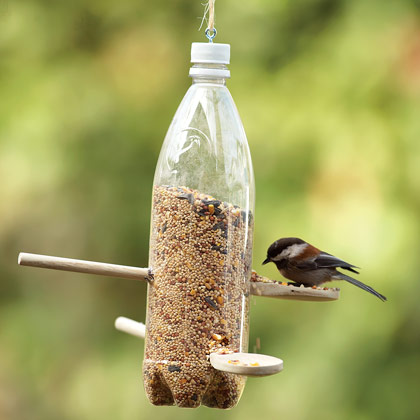
Image from saavyhousekeeping.com

Poke holes in water bottle where the pencil or spoon will go through. Then you need to cut a small hole above that one so the birds can perch on the pencil and reach in to get seeds. You can cut one set of holes or two as shown in the picture above. Once you have your holes cut, add your pencils or spoons and fill with seed.

What birds come to your feeder? The more mixed your seed, the greater the mix of birds. I refilled my bird feeder this morning and it took a male and female cardinal less than two minutes to come to the feeder.

Wednesday, March 9, 2011

Book Review: Feathers for Lunch

Feathers for Lunch by Lois Ehlert is one of my very favorite field guides - trust me I not only have a lot of field guides, I've read even more. This is a story about a house cat who escapes in to the yard and encounters a dozen common backyard birds. Each bird is illustrated in detail that will allow identification of the bird.

The back of the book has a traditional field guide layout for each bird but in a streamlined form showing the most basic of information.

There are a few ways to use this book with your preschooler. First you can just read it and talk about how the cat is a predator and the birds are prey. The cat isn't effective as a predator since he has a bell. Why did his owners put a bell on the cat?

Another fun way to use the book is as a field guide. You can check out the birds at your feeder and see what birds you have. The book can help you identify the birds you have and since there are on a few, and the most common birds, you won't get lost wondering what bird you have.

Lois Ehlert uses paper to make her pictures. Can you cut out different shaped pieces of paper and create pictures of the birds you see?

5 out of 5 stars.

Monday, March 7, 2011

Animal of the Week - Squirrels

Image from judywoods.com

This time of year squirrels, like this grey squirrel, may be the most common visitor to your bird feeder. Many birds are starting to find some juicy bugs and seeds that were covered with snow and our squirrel friends are still waiting for the ground to defrost before they can dig deep to find their hidden caches of nuts.

Squirrels' primary habitat is mature woods - woods with big trees and some under brush, but because they can find food there, many squirrels are moving into places like parks and suburban neighborhoods.

In the winter, squirrels will nest in a cavity, often one left by a bird. They will store some food and line the nest with sticks, leaves, and sometimes fur for insulation. In the summer, squirrels build a nest of leaves and sticks a bit bigger than a basket ball. This summer nest is called a drey.

Unlike most other species of squirrel, the grey squirrel will eat birds and eggs in addition to the traditional squirrel diet of nuts, seeds, mushrooms, pine cones, fruits, and bark.

We love to watch the squirrels at our feeders. We have three grey squirrels and at least on red squirrel. They are quite bold and very funny to watch as they seem to play with each other and carry on great conversations.


Friday, March 4, 2011

Fun Friday Fact

Could dinosaurs spit?

In the movie Jurassic Park, a Dilophosaurs spits venom in a man's face. Alas, there is no physical evidence that dinosaurs could spit. It takes a lot of muscle to spit and that probably would have left marks on the skeletons of dinosaurs.

There are snakes such as the Spitting Cobra that appear to spit venom, but they really just spray their venom. The have large muscles that allow them to eject venom quite accurately.

Check out this video of a spitting cobra, well spitting. It is under two minutes and very well done.

Thursday, March 3, 2011

Make your own Fossils

Using modeling clay or Model Magic and objects like ferns, feathers, bones, or shells, you can create a fossil.

We just did this at the library and made all kinds of impressions from shells to toy dino prints to car tracks.

Flatten a piece of clay with your hand and press an object into it. You can just stop here and let the clay or Model Magic to dry and then paint it. This is how foot prints are fossilized.

If you are ready for a more realistic fossil, you can use plaster or clay. Carefully roll out another piece of clay about the same size. Cover the object with the second piece of clay and be sure it molds to the object. Gently pull the clay apart and you will have two impressions of your fossil! Once dry, you can paint the clay to look like rock.

Tuesday, March 1, 2011

Book Review: Dinosaurs Big and Small

I am a huge fan of Kathleen Zoehfeld - I really love all her books. She takes very complex topics and makes the very accessible with out talking down to me.

Dinosaurs Big and Small demonstrates how long and tall dinosaurs were and more importantly to me, she talks about how we know this information. The next question most kids, and adults might have is how heavy dinosaurs were. Kathleen handles this extremely well. Scientists don't actually know how heavy dinosaurs were and can only make some well educated guesses.

The best part of this book is how they measure things. While using standard measurements of feet and pounds for everything, she also puts the measurements in context for kids by measuring in kid units. She also measures in elephants for weight which is a way scientists do to.

I give it a 4 out of 5 stars.

Dinosaurs in the library!

We had dinosaurs in the library today! We had a great time exploring just how really big some of the dinosaurs were and how small some of them were. We know a lot about dinosaurs from fossils so we played paleontologist, scientist who studies dinosaurs, by digging out our own dinosaur clues. Then we got to make fossils.

Here are some ideas for exploring dinosaurs with your own paleontologists at home.

What if you had a dinosaur? Make a habitat for your dinosaur in a shoe box, empty tissue box, or on paper. Cut out magazine pictures, use natural materials (pine sprigs, twigs, rocks) or paint your own food, water, and friends for your dino.

Counting. Use dinosaur shaped crackers for counting. If you find dinosaur shaped fruit snacks you can lay them out in a graph before eating to see which color has the most and which color has the least.

Sorting. Gather all your toy dinosaurs and then group into piles with at least two dinosaurs in each pile. What kind of piles did you make? Try again but make fewer or more piles. Try piling them by what foods they ate or when they lived.

Herbivore or Carnivore? Look at your teeth together. Some of our teeth are long, wide and sharp while others are just bumpy. What do we use our teeth for? What do the front teeth do better than the back teeth? You can extend this at lunch by offering meat like a hot dog and plants like lettuce or carrots. How do you eat different foods? Dinosaurs were the same way. Plant eaters used their teeth to grind leaves (molar = grind) and plant stems up while carnivores used their slim sharp teeth (incise = cut) to tear into meat. (Humans are omnivores – we eat both plants and meat.)

Dig it! Hide plastic dinosaurs in the sand box or a small box with corn meal. Give your child a small shovel, paint brush, a ruler, a sifter, and a hat as the tools of a paleontologist. They can dig the fossils and use the tools to carefully uncover and measure them. As they dig the dirt, they should put it through the sifter to uncover tiny fossils. You can make footprints or scenes with toy dinosaurs as well.