While we are in the midst of a huge winter storm that is predicted to leave record snow fall, it got me to wondering. What was the largest amount of snow fall recorded in 24 hrs?
Yeah, I really do wonder about stuff like that.
Turns out to have been 76 inches recorded in Colorado in 1921. That is over 6 feet of snow in one day!
I will have a prize for someone who leaves a comment asking another snow or blizzard related comment. Leave your question in a comment box below and I will choose a winner at random on Monday 2/11/13.
Friday, February 8, 2013

Thursday, February 7, 2013
Make your own Magnifying Glass

This was too cool! Check out directions to make your own magnifying glass. It is simple and the directions are quite easy to follow. Go here to find out how.
Tuesday, February 5, 2013
Animal of the week: Red Fox
.
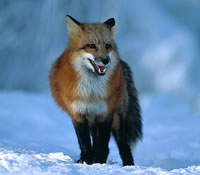
Our local red foxes are out and about this time of year looking for love. Foxes usually mate during the winter and females will have pups in the early spring. They are a nice reddish brown on top and have white bellies. Every description I've read, and pretty pictures like those above, say foxes have darker brown legs, but I haven't really seen that in the wild in this area.
Foxes are omnivorous, like we are. This means they eat all kinds of things including large bugs, small rodents and berries. They love snow because they can hear the mice in tunnels under the snow.
Most of the time, foxes are active at night but they do like to be out just before sunset and can sometimes be see out in the early morning.
When I've been out in the woods near where I live in central Massachusetts, I've come across fox tracks, scat (also known as poop) and their scent far more often than I've seen them. They have a strong musky scent that reminds me of a far away skunk but is very localized on a trail. That means that I take one step and I can smell it and by the time I take a second step, the smell is gone.
Photo from NHPTV.org
Monday, February 4, 2013
5 things to do with a straw

1. Take a straw, a cotton ball and a toy car. Try blowing the cotton ball and see how far across the floor you can push it with your breath. Now try it with the car. Which one was easier to push? Why do you think it was easier? What else can you push with your breath?
2. Grab your straw and some pieces of paper. To be safe the paper should be fairly large. Instead of blowing out, suck in. Can you lift the paper? Try newspaper? What kind of paper can you lift?
3. This is one time you CAN blow bubbles with a straw and not get into trouble! Try blowing bubbles in different kinds of liquids like milk, water, juice or even oil. Were they all the same? Did the bubbles last the same amount of time?
4. Now let's use the straw to hold the liquids. Put the liquid in the straw and put your finger over the opening at the top. Lift the straw out of the liquid but don't move your finger. The liquid will stay in the straw. Lift your finger? What happened the liquid?
5. Make bubbles that you can keep. Pour some paint into a shallow bowl. Add a little bit of water and soap. Blow bubbles and then carefully lay a piece of paper over the top. The bubbles will be captured on the paper. You can try adding different colors of paint to see what colors emerge.
Sunday, February 3, 2013
Birthday Candle Experiment

Put a small amount of baking soda in the bottom of a tall glass. Add an equal amount of vinegar. Don't worry you won't be pouring this on your cake! Tip the glass toward the candle as if you were going to pour the liquid on it. Instead after a moment the candle will wink out.
So what happened?
The classic baking soda/vinegar mixture produces carbon dioxide, which is heavier than air and can be poured from the glass to put out the candle.
Neat trick and keeps your cake germ free!
Saturday, February 2, 2013
Groundhogs!

On Groundhog's Day everyone is watching for a groundhog in Pennsylvania to see, or not see, his shadow and predict the onset of spring. Here in New England we won't be seeing groundhogs for a little while longer. Groundhogs, or woodchucks, are one of the handful of true hibernating mammals in Massachusetts.
Around Valentine's Day, these vegetarians will begin to emerge from their winter dens. They will begin looking for a mate right away and in the spring, the females will usually have a litter of 4-6 pups.
photo from National Geographic.
Friday, February 1, 2013
Fun Friday Fact
Polar bears are really black.
No - I am not joking. Their skin is black and their fur is clear but there is so much of it it looks white. The sun's warmth gets trapped behind the fur just like a car window. The black skin is warmer than white. All this works together to keep the polar bear warmer.
No - I am not joking. Their skin is black and their fur is clear but there is so much of it it looks white. The sun's warmth gets trapped behind the fur just like a car window. The black skin is warmer than white. All this works together to keep the polar bear warmer.
Subscribe to:
Posts (Atom)

 Posts
Posts


