Showing posts with label birds. Show all posts
Saturday, February 16, 2013
Book Review: Crinkleroot's Guide to Knowing the Birds
Crinkleroot's Guide to Knowing the Birds by Jim Arnosky is a wonderful field guide to common birds. Like all of Crinkleroot's books it really he frames well how to *be* in nature. He always talks about when to be quiet and when to be loud, when to step softly and when to run.
In this book he talks about how to make a bird count and how to use binoculars, two important skills in bird watching. He also shows some ways to attract birds to your yard.
I hesitated a long time to recommend this book for one reason, it isn't available for purchase at a reasonable price. So this is something to check out of the library and to hunt for a book sales.
I give it 4.5 out of 5 stars.
Friday, February 15, 2013
Bird Experiments
It is really fun to see the different birds in our backyard. Just over a year ago, my daughter went the Worcester Art Museum and made a bird feeder. They gave her a little packet of seeds that she put in the feeder. Within about 10 minutes we had a Rose-breasted Grossbeak at her feeder. This was amazing! It was only the second time we'd seen the bird in our yard and we have feeders up most of the time.
What was the difference? The Rose-breasted Grossbeak was attracted by a different kind of seed that was in the WAM mix and not in our usual mix.
We learned that different kinds of food attract different kinds of birds. My friend Melissa just learned today that American Goldfinches really like thistle seeds. What would happen if you put different kinds of seeds out at a feeder? Would some birds like fruit and others peanut butter?
So here's your challenge... put out different kinds of bird seed and some fruit (like a string of raisins or cranberries) and see who eats what.
Here are directions to a simple bird feeder. If you don't want to use peanut butter try shortening or beef suet.
Here is my favorite bird identification book.
What was the difference? The Rose-breasted Grossbeak was attracted by a different kind of seed that was in the WAM mix and not in our usual mix.
We learned that different kinds of food attract different kinds of birds. My friend Melissa just learned today that American Goldfinches really like thistle seeds. What would happen if you put different kinds of seeds out at a feeder? Would some birds like fruit and others peanut butter?
So here's your challenge... put out different kinds of bird seed and some fruit (like a string of raisins or cranberries) and see who eats what.
Here are directions to a simple bird feeder. If you don't want to use peanut butter try shortening or beef suet.
Here is my favorite bird identification book.
Wednesday, February 15, 2012
Five Fun things to do with Feathers
I was going to post this earlier in the week but with Valentine's Day, I thought I'd better wait!
1. Check out the barbs and barbules - the tiny feathers that come from the shaft or stem of the feather are called barbs. Off the barbs are barbules which have hooks like velcro. If you smooth a feather the wrong way (top down) they get all scraggly. Then clean them up by can pretending to preen and smooth your feathers the right way. The barbules will re-hook and the feather will be smooth again.
2. Dip them in water. What might happen? Older feathers, or those that are dyed, might just get wet, but on fresher feathers the water will bead up. Birds have oil glands that they use to keep their feathers water resistant.
3. Paint - paint with the feathers using slightly runny paint or water color paint. Different feathers will make different patterns.
4. Make a game. Tie up a bundle of feathers to make a shuttle cock game played by native American children. Here is a description.
5. See how long you can keep a feather in the air with your breath. Blow the feather up in the air and you can count or use a stop watch to see who can keep a feather in the air the longest.
I collected these feathers just from my backyard. I can remember as a kid hearing that I shouldn't pick up feathers in case they had germs. Well "germs" that affect birds don't usually affect humans. Yes, there is an avian flu but it isn't going to be carried by your average backyard bird or their dropped feathers.
One thing to note is that you cannot pick up feathers from migratory or endangered birds. Just don't even think about it. What you see above are Turkey, Blue Jay and Mourning Dove feathers.
1. Check out the barbs and barbules - the tiny feathers that come from the shaft or stem of the feather are called barbs. Off the barbs are barbules which have hooks like velcro. If you smooth a feather the wrong way (top down) they get all scraggly. Then clean them up by can pretending to preen and smooth your feathers the right way. The barbules will re-hook and the feather will be smooth again.
2. Dip them in water. What might happen? Older feathers, or those that are dyed, might just get wet, but on fresher feathers the water will bead up. Birds have oil glands that they use to keep their feathers water resistant.
3. Paint - paint with the feathers using slightly runny paint or water color paint. Different feathers will make different patterns.
4. Make a game. Tie up a bundle of feathers to make a shuttle cock game played by native American children. Here is a description.
5. See how long you can keep a feather in the air with your breath. Blow the feather up in the air and you can count or use a stop watch to see who can keep a feather in the air the longest.
I collected these feathers just from my backyard. I can remember as a kid hearing that I shouldn't pick up feathers in case they had germs. Well "germs" that affect birds don't usually affect humans. Yes, there is an avian flu but it isn't going to be carried by your average backyard bird or their dropped feathers.
One thing to note is that you cannot pick up feathers from migratory or endangered birds. Just don't even think about it. What you see above are Turkey, Blue Jay and Mourning Dove feathers.
Wednesday, May 25, 2011
Book Review: Birds, Nests, and Eggs
Birds, Nests, and Eggs by Mel Boring is a good introductory field guide for young children. I have reviewed another book, Feathers For Lunch by Lois Elhert, that I love. This one I like a lot. The illustrations are clear and the text is easy to understand. It does go that extra step to show what bird eggs and nests look like for the different species of bird. That being said, it is really hard to see most bird nest and eggs. Birds are naturally secretive about their nests so the best time to see them is in the fall when they are abandoned and the leaves have fallen.
I would start with Feathers for Lunch and if you child is super interested in birds, then this is a good next step.
3/5 stars.
Thursday, March 10, 2011
Making a bird feeder
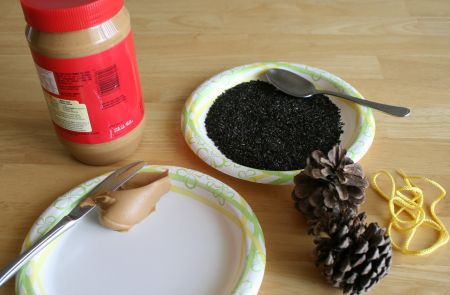
Image from MakeandTakes.comThis is a classic activity to do with your preschooler. It is messy and lots of fun. Using a pine cone, some string, peanut butter and bird seed, you can create a bird feeder the birds will flock to. Tie the string on to the pine cone first, then slather the pine cone with peanut butter. Roll the pine cone in bird seed and you are done! Hang up in location you can see from a window.
If your child is allergic to peanuts, solid shortening can be substituted. Also check your bird seed to make sure it doesn't contain peanuts.

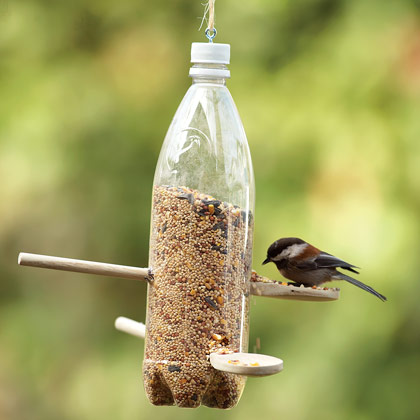
Another fun bird feeder to make that reuses material, is a water bottle bird feeder. You need a water bottle, scissors, pencils or spoons and bird seed.

Image from saavyhousekeeping.com
Poke holes in water bottle where the pencil or spoon will go through. Then you need to cut a small hole above that one so the birds can perch on the pencil and reach in to get seeds. You can cut one set of holes or two as shown in the picture above. Once you have your holes cut, add your pencils or spoons and fill with seed.
What birds come to your feeder? The more mixed your seed, the greater the mix of birds. I refilled my bird feeder this morning and it took a male and female cardinal less than two minutes to come to the feeder.
Subscribe to:
Posts (Atom)