Showing posts with label Animal of the Week. Show all posts
Monday, February 18, 2013
Animal of the Week: Skunks
Skunks are a great animal to learn about this time of year. True to the phrase Love Stinks, skunks are out of hibernation right around now and have only one thing on their mind: love. They can be quite cranky and quick to spray so if you see one, give them a wide berth.
Skunks live in all of the lower 48 states and there are multiple varieties but they are all the classic startling black and white. This is a warning to others that they are dangerous.
The spray they are most well-known for is not harmful but it is a good deterrent to anyone who has been sprayed, or had a pet sprayed!, to back off.
Of real concern is rabies. Skunks do carry rabies and you should call your local animal control officer if you find a skunk out and about during the day acting strangely. Like all wild animals, never handle a wild skunk.
To keep skunks away from your house, make sure that all potential den sites are covered and your trash cans have sturdy well-fitting lids. Skunks love dog food so don't feed your pet outside. Skunks are omnivorousness just like we are and they love to eat grubs in the spring and early summer. When you see little dig spots all over your lawn, a skunk has probably been by.
We have a skunk in our neck of the woods most years. They have very distinct foot prints that are often easy to find in the snow. As a beekeeper, skunks can be quite troublesome. They love to eat bees at night. They will scratch on the hive and a bee will fly out. The skunk catches the bee in flight and rolls it on the ground to kill it.
photo credit: ABCnewsgo
Tuesday, February 5, 2013
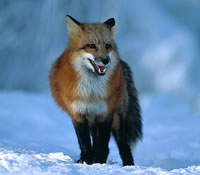
Animal of the week: Red Fox
Our local red foxes are out and about this time of year looking for love. Foxes usually mate during the winter and females will have pups in the early spring. They are a nice reddish brown on top and have white bellies. Every description I've read, and pretty pictures like those above, say foxes have darker brown legs, but I haven't really seen that in the wild in this area.
Foxes are omnivorous, like we are. This means they eat all kinds of things including large bugs, small rodents and berries. They love snow because they can hear the mice in tunnels under the snow.
Most of the time, foxes are active at night but they do like to be out just before sunset and can sometimes be see out in the early morning.
When I've been out in the woods near where I live in central Massachusetts, I've come across fox tracks, scat (also known as poop) and their scent far more often than I've seen them. They have a strong musky scent that reminds me of a far away skunk but is very localized on a trail. That means that I take one step and I can smell it and by the time I take a second step, the smell is gone.
Photo from NHPTV.org
Labels:
Animal of the Week,
fox,
Preschool science,
winter
Saturday, February 2, 2013
Groundhogs!
On Groundhog's Day everyone is watching for a groundhog in Pennsylvania to see, or not see, his shadow and predict the onset of spring. Here in New England we won't be seeing groundhogs for a little while longer. Groundhogs, or woodchucks, are one of the handful of true hibernating mammals in Massachusetts.
Around Valentine's Day, these vegetarians will begin to emerge from their winter dens. They will begin looking for a mate right away and in the spring, the females will usually have a litter of 4-6 pups.
photo from National Geographic.
Monday, December 3, 2012
Animal of the Week: Honeybee
I am a beekeeper and I have Honeybees. Honeybees are one of about 20,000 different species of bee. Some you are probably familiar with like the bumble bee and the carpenter bee. Other bees you will probably hear about in the New England area are Mason bees and Red bees.
Honeybees make honey by drinking the nectar of flowers, putting that in a special honey stomach and then back at the hive, they put the nectar in a cell and evaporate out nearly all of the water. Yum!
One of the most common questions I hear this time of year is what do they do in the winter. Bees cuddle for the winter! They use their body heat to keep their mom, the Queen warm and they keep the temperature in the hive just over 60'F. Beekeepers call it a cluster.
When ever the temperature is 50'F or over the bees fly around. They are really enjoying flying today gathering any last remaining pollen and cleaning up the honey I left out for them.
Go bees!!
Wednesday, November 30, 2011
Animal of the Week: Bears
Bears capture the imagination of kids everywhere. Many of us have loved bears since we were little and were carrying a stuffed one around with us. Mine was called Theodora and she looked like she was a basic brown bear.I believe that one of the reasons we love bears so much is that they are like us in many ways.
Bears are mammals – just like people
Bears are omnivores – they eat meat and plants – just like people
Bears care for their young into adulthood - just like people.
Here are some other interesting facts about bears:
There are eight different species of bears. They are Asiatic, Black, Brown, Polar, Panda, Sloth, Spectacled and Sun.
Bears live everywhere in the world except Antarctica and Australia.
Monday, October 17, 2011
Animal of the Week: Leaf Miners
Leaf miners leave a trail inside the leaves of trees and other plants. A mother insect will lay an egg under the skin of a leaf and the egg hatches. The larvae or baby is hungry so it eats the leaf. As the larvae grow, they eat bigger and bigger trails. As the leaves fall from the trees, check to see if you can find any leaf miners. Their trails sometimes have little black specks in them. This is frass or bug poop.
image from diggingredclay.com.
Monday, August 1, 2011
Animal of the Week: Bullfrog
Bullfrogs live in the eastern portion of North America and can be found livening up the nighttime symphony with their deep "jug-o-rum" calls. These guys love to live in ponds and lakes and will eat anything they can get their mouth around. They are as omnivorous as it comes eating fish, grubs, insects, and even other frogs. What about plants, I hear you say? Well, when these guys are tadpoles they eat algae when young and will take on larger prey when they are large enough.
The tadpoles can live two years in a pond before metamorphosing in to frogs. They have big tadpoles and it is worth trolling murky waters with a net this year just to see them. They are fairly dark compared to other more petite tadpoles.
And these guys are actually farmed in the south as a food source. Yum, eh?
Monday, June 6, 2011
Animal of the Week: Monarch Butterfly
Monarch butterflies are just coming out in this area. They are large orange butterflies with black markings. The one pictured above is a male - you can see the two spots on his hind wings.For some basic biology on butterflies, check out a previous post here.
Monarch butterflies have a long distance migration where they spend the winter in Mexico.
Milkweed is the Monarch's host plant - that means that as caterpillars, they eat only milkweed. This makes them taste bitter which is why they have such bright coloration. This bright coloration tells birds - Don't eat me, I taste bad!
There will be lots more butterfly fun all week - so keep coming back!
Monday, May 23, 2011
Animal of the Week: American Robin

We have visitors for the next few weeks. An American Robin has put her nest in one of the hanging flower pots on our porch. It is quite exciting to see her sitting on the nest from inside our front door.
Robins like to make nests normally no more than about six feet off the ground. While you cannot see the side of the nest, I can tell you it is made from straw and mud as is quite typical of Robins.
I feel like an auntie!
Monday, May 16, 2011
Animal of the Week: Chipmunks
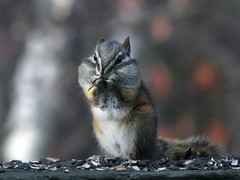
Photo from http://www.flickr.com/photos/stellaretriever/.Chipmunks are fun mammals to watch in your yard. They are all over right now in New England. Generally these guys are crepuscular - that is a fancy science word for active at dawn and dusk.
Chipmunks usually eat seeds and other plant materials but may eat the occasional snail or larvae. They do store food in the fall and hibernate in the winter.
They generally make their burrows in open woodland areas or on the edges of wooded areas, but will live in suburbia as well. The entrances to their burrows are little round, two-inch holes in the ground.
If you put out bird seed on the ground, you might get a good look at a chipmunk in the morning or evening before dark.
Monday, May 2, 2011
Animal of the Week - butterflies
I saw my first Spring Azure this past weekend. So butterfly season is upon us! Butterflies are insects - that means they have three body parts, six legs and wings as adults. They have an exoskeleton and that means their skeleton is on the outside.
Butterflies have a complete metamorphosis (remember that is the science word for change) going from an egg to a larvae (caterpillar) to a chrysalis and finally to an adult butterfly.
Butterflies eat nectar as adults. They have a long proboscis (tongue) that is hollow. They slurp up the nectar from plants. As larvae they also eat plants but as babies they eat the leaves of plants.
Butterflies can fly as fast as 12 miles per hour. While that may be faster than I can run, the fastest human being can run about 22 miles per hour.
Monday, April 25, 2011
Animal of the Week - Rabbits
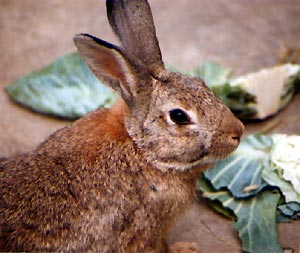
Photo from http://www.copyright-free-photos.org.uk/rabbits/01-cute-rabbit.htm.In our post chocolate and jelly bean haze, I thought it might be fun to learn about real rabbits this week.
Cottontail rabbits, the most common of six species of rabbits in the US, can be found in almost any grassy habitat. Rabbits are vegetarians and eat plants in the warmer weather and bark and twigs in the winter. They most often come to people's attention when they start eating tender plants set out in the spring.
Rabbits can live as long as two years in the wild and they do have lots of babies. Rabbits can have up to four litters in a year with as many as eight babies in each litter.
For your best chances of seeing a rabbit, you have to get up early or stay up late - rabbits are most often seen at dawn and just after dusk.
Monday, April 18, 2011
Animal of the Week - Earthworms
Image from gagetscience.com Earthworms are wicked cool creatures. The tunnel through soil helping air and water to circulate more freely and their poop is down right legendary. Worms eat all kinds of dead material, chew it up and then poop it out. Worm poop is called castings.
Ranging in size between a few inches and 22 feet long, earthworms can be found on every continent except Antarctica. The biggest worms are found in souther Africa and Australia. There are some worms in the Pacific northwest can be around two feet long. One species in the Philippines is blue!
Worms don't have eyes like we do, but they do have cells in their body that are sensitive to light. Generally they burrow or turn away from the light.
Worms breath through their skin - so if you pick them up - and who doesn't! - make sure you don't have bug spray on them.
Monday, April 11, 2011
Animal of the Week - Chickens
Image from mypetchicken.comWe are surrounded by marshmallow chickens and chocolate bunnies this time of year so it seems fitting that we learn a bit about the real animals. This is a picture of a Polish breed - they are small and only lay two eggs per week.
An adult male chicken is a rooster and an adult female is a hen. Babies are called chicks.
Even though chickens are birds with lovely feathers, they cannot fly very far or very well.
There are over 100 different varieties of chickens and many lay eggs that are not white. Some lay pink, blue and even polka dotted eggs.
Chickens are omnivores and will eat seeds, nuts, small insects, worms and fruit.
Tuesday, April 5, 2011
Animal of the Week
It is National Frog Month and this week we are celebrating FROGS!
Frogs are an important part of our ecosystem. They eat bugs - and that is just one of the things that is really important about them. Frogs breath through their skin as well as their lungs. Chemicals or pollution in water ways can damage or kill frogs. They warn us about environmental problems that are water related.
And they are just so darn cool.
Mama frogs lay eggs in ponds, lakes, puddles, and in some places, in flowers. The eggs hatch and become tadpoles. Then they need to become frogs to hop out of the water.
Frogs come in all sorts of colors. The one at the top of the page is a Green Frog, but frogs can be red, yellow, green, blue, brown, orange, and even purple.
Monday, March 28, 2011
Animal of the Week - Snow Monkey
Image from heartcurrents.comSnow monkeys are an iconic image of Japan, the theme of the week. All our hearts and minds are still in Japan as people still struggle with the aftermath of earthquakes and nuclear concerns.
The Japanese word for money is saru and these monkeys are the most northern dwelling monkey in the world.
They are omnivores just like us. That means they eat both plants and animals. Their diet is usually seeds, nuts, insects, eggs, berries, fungi and roots.
These snow monkeys live in family groups headed by the females.
Monday, March 21, 2011
Animal of the Week - Blue Tongued Skink
Image from www.reptileweb.comThere are five different groups of reptiles and a lizard is one. On Saturday, I had the opportunity to meet a Blue Tongued Skink.
Unlike many other lizards, the Blue Tongued Skink doesn't move very quickly, so to evade predators, it sticks its blue tongue out to scare them.
They are native to Australia, New Guinea and Tasmania. The female gives birth, not to eggs like most lizards, but to live babies like humans do. Cool.
Monday, March 14, 2011
Animal of the Week - River Otters
Image from Marylandzoo.orgRiver otters will live in all kinds of water, not just rivers. They like to have fresh water where they can swim, hunt for prey, and play.
On land, they use their senses of smell and sight to find they prey. They eat fish, amphibians, crustaceans and if they can catch them, small mammals.
When they dive in the water, otters use their sensitive whiskers to find prey.
River otters like to slip and slide in the mud and snow.
Locally, check out the Blackstone River Bike Trail for otters. I have seen them there twice.
Monday, March 7, 2011
Animal of the Week - Squirrels
Image from judywoods.comThis time of year squirrels, like this grey squirrel, may be the most common visitor to your bird feeder. Many birds are starting to find some juicy bugs and seeds that were covered with snow and our squirrel friends are still waiting for the ground to defrost before they can dig deep to find their hidden caches of nuts.
Squirrels' primary habitat is mature woods - woods with big trees and some under brush, but because they can find food there, many squirrels are moving into places like parks and suburban neighborhoods.
In the winter, squirrels will nest in a cavity, often one left by a bird. They will store some food and line the nest with sticks, leaves, and sometimes fur for insulation. In the summer, squirrels build a nest of leaves and sticks a bit bigger than a basket ball. This summer nest is called a drey.
Unlike most other species of squirrel, the grey squirrel will eat birds and eggs in addition to the traditional squirrel diet of nuts, seeds, mushrooms, pine cones, fruits, and bark.
We love to watch the squirrels at our feeders. We have three grey squirrels and at least on red squirrel. They are quite bold and very funny to watch as they seem to play with each other and carry on great conversations.
Monday, February 28, 2011
Animal of the Week - Dinosaurs
Image from Gizmopeek.comThis is our Dino Week! Dinosaurs were one of my childhood obsessions! I had so much fun with dinosaurs it wasn't until I was in graduate school that I finally had the thought to become a paleontologist - or someone who studies dinosaurs.
Apatosaurus was my favorite tho we called it Brontosaurus then. Apatosaurus was one of the largest animals ever to live on our planet and they were plant eaters. Measuring almost 90 feet long it dwarfs most other dinosaurs. It's main defenses were its size and tail - it could wipe its tail around and knock other dinosaurs around.
When I was little, Apatosauruses were always shown belly deep in water or in swamps. As more fossil evidence has surfaced, palaeontologists now think they were really land dwellers.
I love how this shows science and scientists ability to change as more evidence is found. If you want to learn more about Apatosaurus, check out this site for young kids.
Subscribe to:
Posts (Atom)